The CREG tariff for home charging
If your employee charges their company car at home, you as the employer reimburse that electricity. Since 2025 the tax authorities have set how much you may pay for it tax-free: a fixed amount per kWh that changes every quarter and differs per region, the CREG tariff. This article explains where that tariff comes from, how it is calculated, what you as an employer have to choose and what Wattify takes care of for you automatically.
What is the CREG tariff?
The CREG (Commission for Electricity and Gas Regulation) is the federal energy regulator. Every month, around the middle of the month, it publishes the average all-in commercial electricity price a household pays: the energy itself, the network tariffs for transmission and distribution, the levies and the 6% VAT. That figure exists separately for Flanders, Brussels and Wallonia, and is based on a household with a digital meter and one electric car that uses 8,000 kWh a year.
It is an average of all commercial contracts on the market. Your employee may have a cheaper or a more expensive contract; the CREG tariff is meant as a fair, cost-covering basis that nobody has to negotiate over. That is why the tax authorities use it as the reference for reimbursing home charging, and why Wattify built it in as the tariff for split-billing.
Why a fixed tariff? The tax rules since 2025
With circular 2024/C/77 of 6 December 2024, FPS Finance (the Belgian federal tax administration) laid down how an employer may reimburse the electricity for charging a company car at home without it being taxed as salary. The conditions:
- It concerns an electric or plug-in hybrid company car that is made available to the employee.
- The charging station at home has a communication system that measures the company car's consumption separately and passes it on to the employer. That can be done directly, or through a charging station operator such as Wattify. An ordinary socket or an estimate is not enough.
- The energy contract is in the employee's name, and the employee pays the energy bill themselves.
- The reimbursement is laid down in the company's car policy.
- For charging stations installed from 2025 onwards: the kWh measurement is accurate to within 2% or meets accuracy class B. The charging stations Wattify connects meet that requirement.
If you meet those conditions, you may use a flat rate instead of proving the actual cost: the CREG tariff for the quarter. That is a maximum. If you reimburse more than the published tariff, the difference is a taxable benefit in kind for your employee, with social security and tax charges as a result. If you reimburse less, there is no tax problem, but your employee bears the difference themselves.
The scheme initially applied to 2025 and has been extended quarter by quarter since: every quarter FPS Finance publishes an addendum with the new maximum. Wattify is not a tax adviser; always run the rules for your company past your payroll agency or accountant.
How is the quarterly tariff calculated?
The flat rate for a quarter is the average of three CREG monthly prices, with a two-month delay so that the figures are certain to have been published:
| Quarter | Average of the months |
|---|---|
| Q1 (January to March) | August, September and October of the previous year |
| Q2 (April to June) | November, December and January |
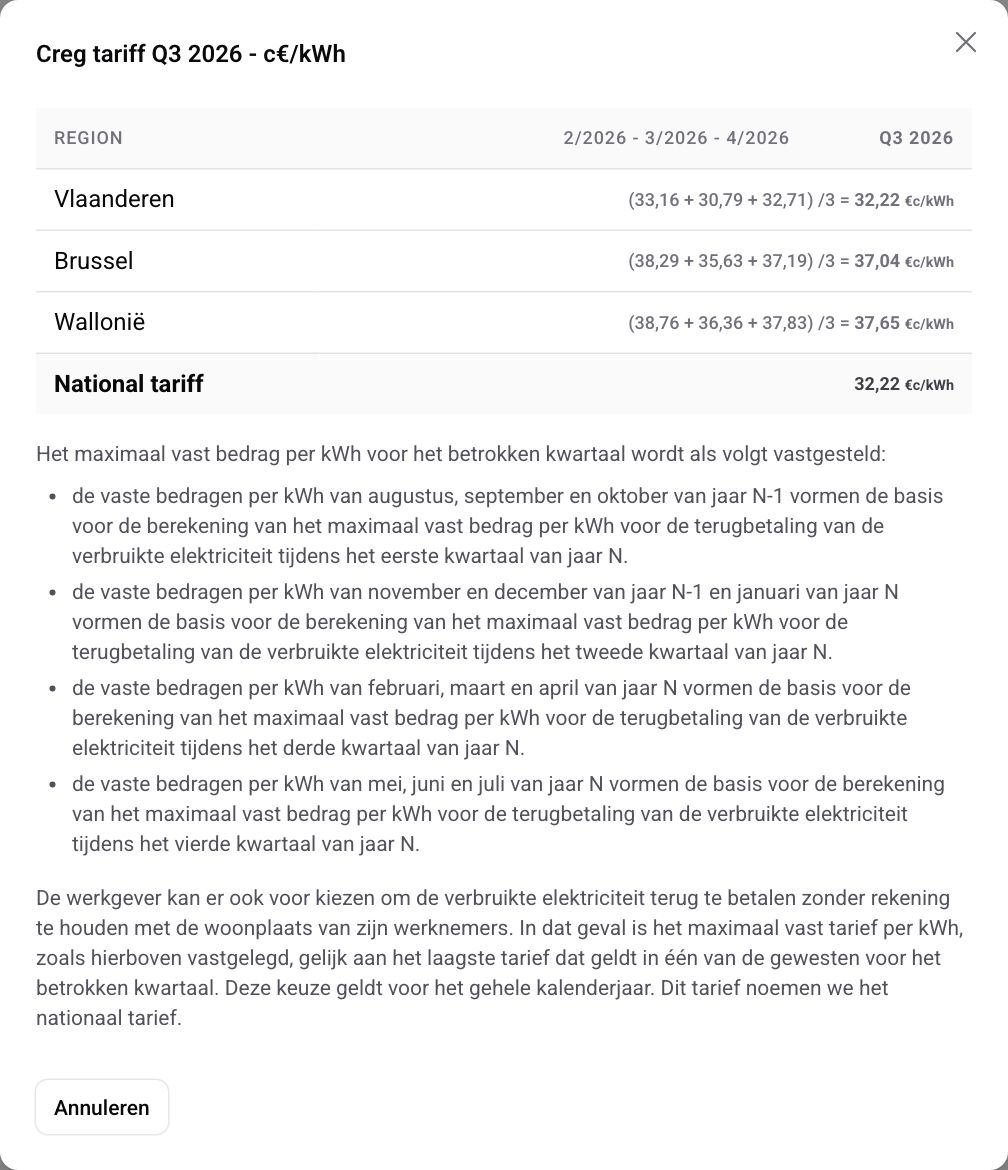
| Q3 (July to September) | February, March and April |
| Q4 (October to December) | May, June and July |
This is what that looks like, in euro cents per kWh and including VAT, as published by the CREG:
| Quarter | Flanders | Brussels | Wallonia |
|---|---|---|---|
| Q1 2025 | 28.22 | 32.94 | 32.56 |
| Q2 2025 | 31.94 | 35.85 | 36.18 |
| Q3 2025 | 34.56 | 37.87 | 38.43 |
| Q4 2025 | 30.70 | 33.56 | 34.57 |
| Q1 2026 | 31.32 | 34.26 | 35.23 |
| Q2 2026 | 31.91 | 35.55 | 36.36 |
| Q3 2026 | 32.22 | 37.19 | 37.83 |
| Q4 2026 | 32.25 | 36.88 | 37.79 |
You will always find the current and upcoming tariffs on the CREG's page CREG tariff for reimbursing home charging of company cars. You do not need to copy them yourself: Wattify reads them in and applies them.
Regional or federal tariff?
The circular lets you as an employer choose between two ways of applying the flat rate:
- Regional: each employee receives the tariff of the region where they live. Wattify determines the region from the address of the charge site, i.e. your employee's home address. This is the default setting.
- Federal: one tariff for all your employees, regardless of where they live. The tax authorities allow this on condition that you take the lowest of the three regional tariffs. In practice that is the Flemish one.
The choice applies for a full calendar year and for all your employees together. If you choose nothing, the regional tariff applies. Record your choice in the car policy, so that what is on paper also matches what Wattify pays out.
What does Wattify do with the CREG tariff?
On a charge site with the Employee home charging station subscription (split-billing), the CREG tariff is always on. Wattify reads in the CREG's monthly prices, calculates the quarterly tariff per region and applies it to every charging session of the company car:
- Every charging session on the home charging station is valued at the CREG tariff of the region and the quarter in which it took place.
- Once a month you as the employer receive one invoice for all your employees' sessions together: the kWh at the CREG tariff, plus Wattify's markup of €0.02 per kWh and the subscription.
- As soon as that invoice has been paid, Wattify pays your employee with a reimbursement note at the CREG tariff, at 0% VAT, to the IBAN in their profile. It is a reimbursement of their own electricity, not a sale.
- On 1 January, 1 April, 1 July and 1 October the tariff switches automatically to the new quarter. You do not have to do anything.
The tariff that currently applies is shown on your dashboard at the top of the usage overview. Click on it and you will see, per region, the three months it was calculated from and the quarterly average.
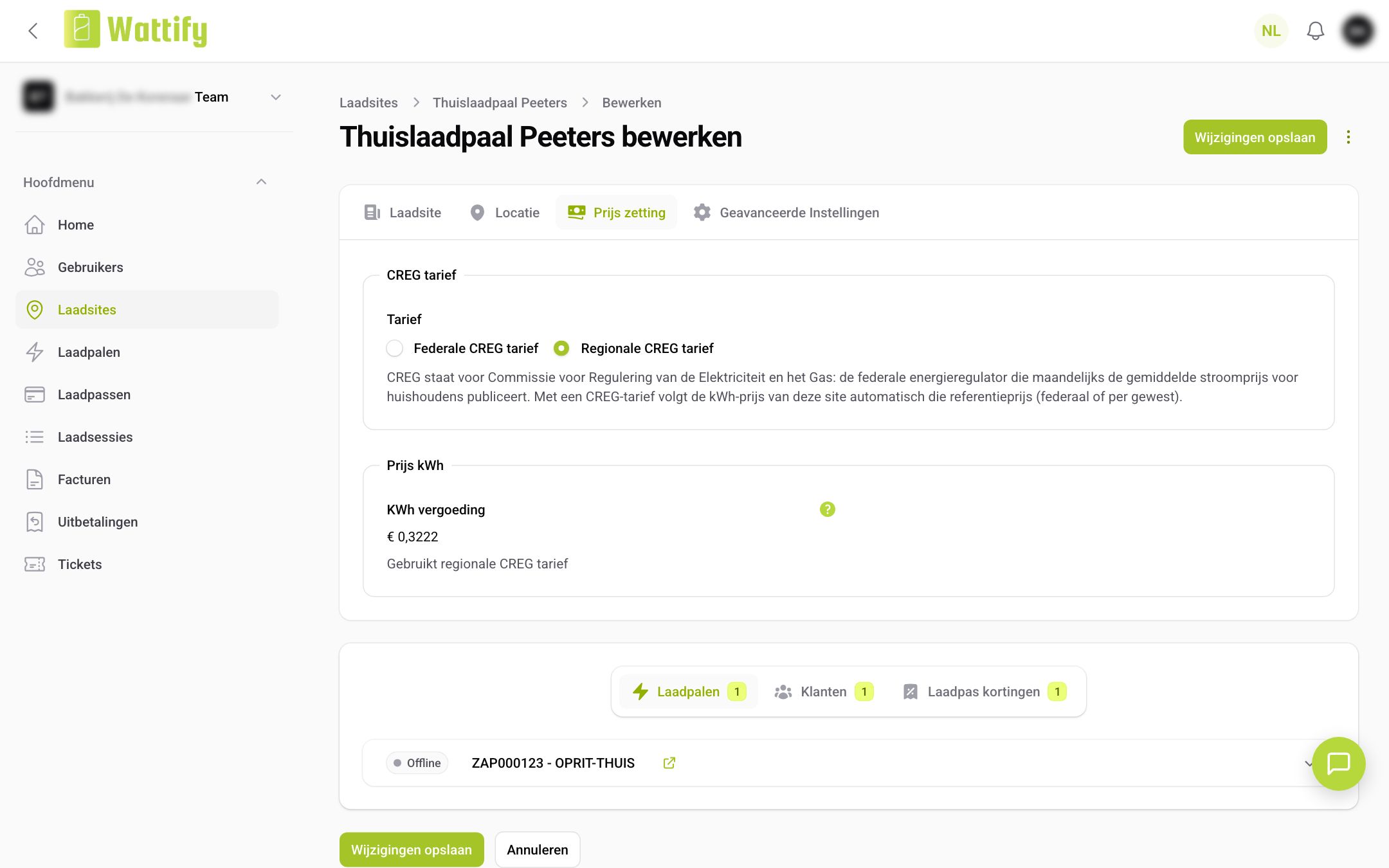
Setting the CREG tariff on your employee's charge site
- In the left-hand menu, go to Charge sites and open your employee's charge site.
- Open the Price setting tab.
- Under CREG tariff, at Rate, choose Regional CREG rate or Federal CREG rate. The KWh fee field below it shows the resulting price; with this subscription you cannot change it yourself.
- Click Save changes at the top right.
The Off option, where you enter a kWh price yourself, only exists for the Public subscription. For an employee's home charging station, a price of your own would undermine the tax scheme, so you are not offered that option there.
Frequently asked questions
Do I have to do anything when the quarter changes?
No. Wattify automatically applies the new tariff to the sessions from the first day of the quarter. That month's invoice uses the new tariff.
Why does the invoice show a different amount from the CREG tariff?
On the employer's invoice, Wattify's markup of €0.02 per kWh comes on top of the CREG tariff, plus the charge site's subscription. Your employee is paid exactly the CREG tariff per kWh.
Does this also apply to a plug-in hybrid?
Yes, the circular applies to electric and plug-in hybrid company cars. The car's consumption does have to be measured separately, which a connected charging station does.
My employee has solar panels or a very cheap contract. May I reimburse less?
You may, the CREG tariff is a maximum. By default Wattify pays out the CREG tariff; if you want a different arrangement, e-mail support@wattify.be.
Where do I find the official figures?
At the CREG, which updates the table every quarter, and in circular 2024/C/77 with its addenda on the FPS Finance website.
Related articles
Did this answer your question
Thank you for your feedback
Did not find an answer?
Our team is just an email away and ready to answer your questions